On Wednesday evening there were five chairs pulled up to the table at The Thinking Spot, the small science bookstore in Wayzata. The last time the What's Next Book Club met, there were three of us. This time one of the five was someone none of us had met. I was encouraged by that.
We were there to talk about Cory Doctorow's Enshittification. I had already written a short review of it, about asking LinkedIn for my own data and finding that it was a small version of Doctorow's cure. Here is what we talked about.
Everyone agreed on the sequence
Nobody argued with Doctorow's description. A platform starts out good to the people who use it, because it needs them to show up. It's a market with two sides, so once the users are there it turns to serving the businesses that sell to them, and it squeezes the users to do it. Then it squeezes the businesses too. All the while it grows, until it is one of only a few places left to go.
The group liked the reverse-centaur most. It was already my favorite idea in the book. A centaur is a person helped by a machine. A reverse-centaur is a person serving one: the system sets the pace and the person takes the blame.
I said there is no balance
Doctorow names four things that used to keep platforms in line: competition, regulation, people's freedom to fix and change what they own, and workers who could refuse. He calls them disciplining forces, because they punish a company that cheats.
At the table I called them four pillars that keep the platform level. Then I said what I had come to believe: in today's extractive kind of capitalism, there is no balance.
The new member called themselves a strong supporter of capitalism, and they also said the checks and balances have gone far out of line. Their view was that for decades we've been riding on the coattails of earlier regulation. The benefits of those old rules outlasted anyone's attention to them. Now that they've been taken apart, we're starting to see what they were holding up.
Everyone had a story
Once we'd been through the book, people brought examples from their own lives.
- Sleep. In 2017 Netflix's chief executive, Reed Hastings, said Netflix competes with sleep. Later that year he added, "And we're winning!"
- Walmart. Someone pointed out that the supplier squeeze is older than the internet. The famous case is a gallon jar of pickles that Walmart sold so cheaply the pickle company was making a penny or two a jar.
- Speakers. One member hadn't read the book but knew Doctorow's ideas from his podcast. Their example was Sonos, the home speaker system, which they said at some point just stopped working. Sonos once permanently disabled old speakers that owners traded in for a discount, and later shipped an app that broke things people used every day.
- Amazon. Everyone had something to say here. The price on the page looks cheap. The squeeze lands on the sellers first and then, slowly, on the customers. Add up the other costs and it isn't cheap. One estimate puts Amazon's take at about 45 cents of every dollar a seller makes there.
- Drivers. When I brought up DoorDash, the whole table nodded. That led to Uber and Lyft, and the way their apps squeeze drivers.
We all came to the same conclusion. A platform that serves its customers by squeezing its suppliers can't keep doing it.
The group's answer: slow down
Since the club's question is what comes next, we tried to answer it. Three answers came out of the evening. The government has to step in. Workers need unions. And each of us needs to slow down and put convenience lower on the list.
That third answer isn't in Doctorow's list. Someone asked whether everything really has to arrive tomorrow, in five separate boxes on five separate trucks. A researcher at MIT estimates that fast shipping raises emissions by 10 to 12 percent for the same orders.
Nobody argued against slowing down.
I checked my own claim afterwards
At one point I said that learning to find your way without GPS is essential to well-being. I said there was a study. Afterwards I couldn't name it, so I looked into it. My claim had four steps: finding your way is foundational learning, GPS stops that learning, the brain weakens without it, and other kinds of thinking suffer as a result.
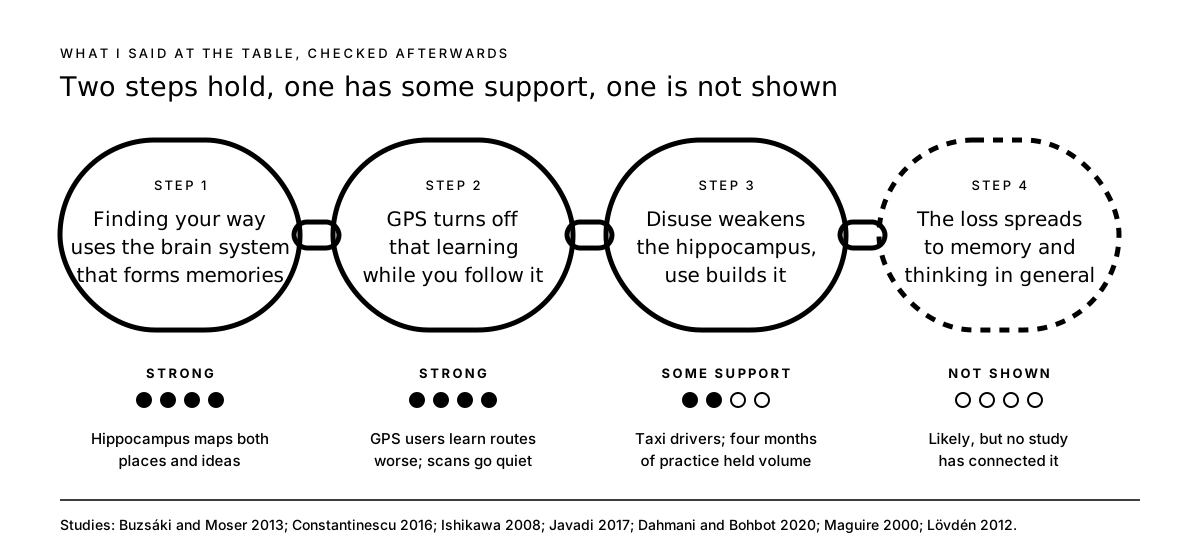
The first two steps hold up well. The part of the brain that makes maps, the hippocampus, is the same part that forms memories, and brain scans show the same map code at work when people organize ideas. People following GPS learn the route far worse than people using a paper map, and scans show the brain's route-planning activity doesn't happen while they follow instructions.
The third step has some support. London taxi drivers who memorize the city have a larger hippocampus. In one study, younger and older men who practiced finding their way for four months kept their hippocampus from shrinking, while the comparison group lost volume.
The fourth step hasn't been shown. Spatial skill predicts who goes into science and engineering, and it can be trained. But no study shows that GPS use lowers memory, reasoning or mood. So here is how I'd say it now. Finding your own way trains the part of the brain we also use to remember and to arrange ideas. GPS turns that training off while it runs. The loss probably spreads to the rest of our thinking, but nobody has shown it.
We left without a plan
There was a lot of hand-wringing at the end, and no concrete ideas about what to do. Everyone could see the problem. Nobody left with a next step.
Still, there were five chairs at the table this time instead of three.